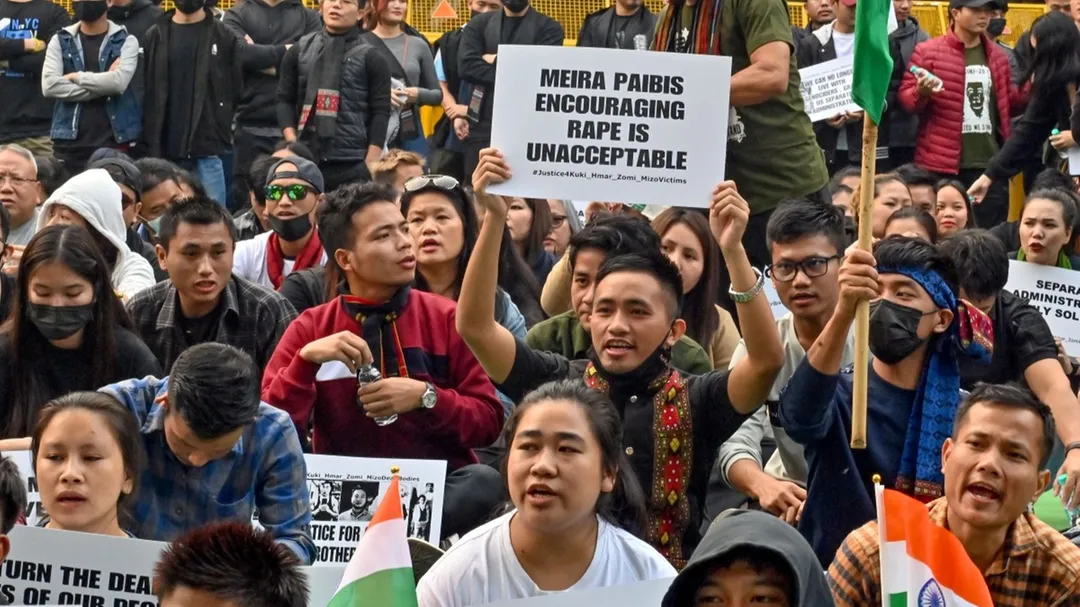
The current political crisis in Manipur has become one of the most complicated and disputable political questions in the Northeast of India. What started as ethnic violence in May 2023 has since evolved to a deeper discussion: should the call to separate administration or Union Territory status of the Kuki-Zo community be heeded in the name of safety, or would it cause even more instability in the region?
A War that is unwilling to die.
Almost three years following the violence that broke out between the Meitei and Kuki-Zo groups, the scenario is not stable. Authorities and independent estimates put the number of killed at more than 260 people, wounded at more than 1,000, and displaced at 60,000-70,000 since May 2023. By 2025, approximately 57,000 displaced people continue to reside in more than 360 relief camps, some of which are overcrowded and in deplorable conditions. The numbers are indicative of not only failure of law and order, but also a long-term humanitarian crisis.
Recent developments show that peace is still fragile. In April 2026, new violence resulted in the deaths of at least four individuals, including children, causing curfews and internet disconnections – which means that the situation is not resolved. To keep a pulse on the ground realities of these events, many turn to a reliable North East news platform for daily updates.
The Requirement of Separate Administration.
The demand by certain quarters of the Kuki-Zo community to have its own administrative unit, in terms of either a Union Territory or autonomous region lies at the heart of the controversy. This argument bases on security and identity. A large number of the hill district people think that coexistence with the existing state setup is no longer possible because of the strong mistrust and frequent violence. The call was fueled by claims that state institutions had not done enough to safeguard minority tribal communities in the course of the violence. As thousands of people continue to be displaced and cannot go back to their homes, the separation calls are presented in the context of survival and not politics.
The Stability Argument
The major opposition to separate administration is raised by the Meitei community and some political stakeholders who insist that separate administration would permanently tear apart in the territorial integrity of Manipur. They caution that by giving into such demands, they would have given precedence to more division in the Northeast of India. There is also the point of the critics that the war is not entirely administrative but rather based on historical, ethnic, and land-based reasons. The Meitei valley population which is basically 10 percent of the land controls political authority, tribal communities occupy the 90 percent left behind, a source of historical grievances. In this way, redrawing administrative borders might not solve the problems that are at the core- it could further entrench divisions.
Breakdown of Governance and Political Fallout.
The crisis has revealed some serious issues of governance. The situation was so bad that the Chief Minister of the state resigned in 2025, and the central rule was imposed. Authorities have been criticized by the human rights organizations because of lack of accountability and justice. Even after two years, many displaced families are yet to go back to their homes despite the magnitude of violence, as rehabilitation and reconciliation have been slow. Also there are reports that the conflict had also severely hampered civilian administration and local policing, further undermining the faith in the state machinery. Monitoring these shifts through latest Manipur ethnic news provides essential insight into whether the administrative divide is deepening or healing.
A National and Regional Security Issue.
The effects of the Manipur crisis transcend the state boundaries. The situation has been made complicated by its closeness to Myanmar, which in itself is unstable, and cross-border migration and security issues. Analysts caution that instability will be a breeding ground to insurgency, proliferation of arms and radicalization of ethnic groups. The fact that there exist several armed groups and militant youth organizations are already increasing the danger and complicate the conflict.
See also: Crypto Technology and Economic Growth
Conclusion
The issue of statehood or stability in Manipur is just a symptom of a more profound crisis of state, identity, and trust. Although the need to separate administration is a matter that manifests real fears and grievances, it also provokes significant concerns regarding the unity and peace in the long term. Separation and status quo will not lead to long-term stability without the meaningful dialogue, accountability, and inclusive political solutions. In the state of Manipur which is today at the crossroads- each decision made involves the danger of either mending or aggravating one of the most serious internal conflicts in India.