The landscape of elite business education in the United States is undergoing its most significant transformation since the introduction of the GMAT. For decades, the “hard” metrics—standardized test scores, GPA, and years of corporate experience—were the primary gatekeepers of the M7 (the top seven US business schools). However, as we move into 2026, a new currency has emerged in the admissions office: Emotional Intelligence (EQ).
The “Holistic” Pivot: Why EQ Matters Now
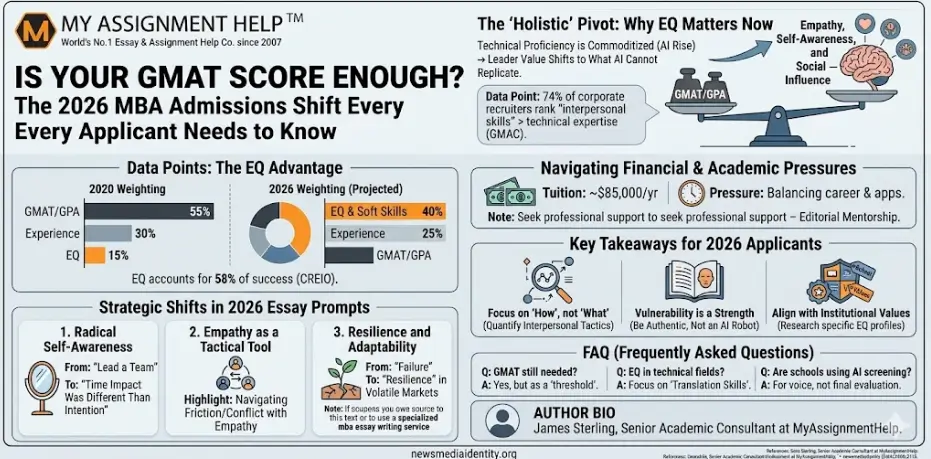
The rise of generative AI in the professional world has commoditized technical proficiency. When an algorithm can perform financial modeling or market analysis in seconds, the value of a leader shifts toward what AI cannot replicate: empathy, self-awareness, and social influence.
According to recent data from the Graduate Management Admission Council (GMAC), 74% of corporate recruiters now rank “interpersonal skills” as more important than technical expertise for MBA hires. Consequently, schools like Stanford GSB and Wharton have restructured their essay prompts to probe deeper into a candidate’s “inner architecture” rather than just their resume highlights.
Navigating the Financial and Academic Pressures of 2026
The 2026 academic cycle is also defined by a tightening economy. With tuition at top-tier US programs hovering around $85,000 per year, the stakes for a successful application have never been higher. This pressure often leads candidates to seek professional support to ensure their narrative is flawless.
In an era where many students are balancing full-time careers while preparing their applications, the trend of writing papers for money has evolved into a sophisticated consulting industry. Modern applicants aren’t looking for shortcuts; they are looking for editorial mentorship to help translate their complex professional lives into the specific “EQ-centric” language that 2026 admissions committees demand.
Data Points: The EQ Advantage
Research from the Consortium for Research on Emotional Intelligence in Organizations suggests that EQ is the single biggest predictor of performance in the workplace, accounting for 58% of success in all types of jobs. Admissions officers have taken note.
| Admission Factor | 2020 Weighting | 2026 Weighting (Projected) |
| GMAT/GRE Score | 35% | 20% |
| Professional Experience | 30% | 25% |
| EQ & Soft Skills (Essays/Interviews) | 15% | 40% |
| Undergraduate GPA | 20% | 15% |
Strategic Shifts in the 2026 Essay Prompts
How does EQ manifest in a 500-word essay? It’s no longer about what you achieved, but how you managed the human elements of that achievement.
1. Radical Self-Awareness
Prompts are moving away from “Tell us about a time you led a team” toward “Tell us about a time your impact was different than your intention.” This requires an applicant to admit to a lack of awareness and demonstrate the growth that followed.
2. Empathy as a Tactical Tool
Schools are looking for “Social Awareness”—the ability to sense others’ emotions and understand their perspectives. Your essays should highlight instances where you navigated cultural friction or mediated conflict using empathy rather than authority.
3. Resilience and Adaptability
The “failure” essay is now the “resilience” essay. In the volatile 2026 job market, admissions committees want to see how you handle ambiguity. Using a specialized mba essay writing service can help candidates identify these subtle EQ markers in their own history that they might otherwise overlook.
Key Takeaways for 2026 Applicants
- Focus on the “How,” not the “What”: Quantify your EQ by describing the specific interpersonal tactics you used to achieve a business goal.
- Vulnerability is a Strength: Admissions officers in 2026 are looking for authentic human beings, not polished corporate robots.
- Align with Institutional Values: Research the specific EQ “flavor” of your target school (e.g., Kellogg prizes collaboration; Harvard prizes high-stakes influence).
See also: Turbine Blend Polish Peen Services: Enhancing Performance and Component Life
FAQ: Frequently Asked Questions
Q: Do I still need a high GMAT score in 2026?
A: Yes, but it is now a “threshold” rather than a “decider.” Once you meet the school’s academic floor, your EQ-based essays become the primary differentiator.
Q: How do I demonstrate EQ if I work in a technical field like Engineering?
A: Focus on “Translation Skills”—how you explain complex data to non-technical stakeholders or how you managed morale during a difficult project sprint.
Q: Are US schools using AI to screen for EQ?
A: Many schools use sentiment analysis tools to ensure the “voice” of the essay is consistent, but the final evaluation of EQ remains a deeply human process performed by the admissions committee.
Author Bio
James Sterling is a Senior Academic Consultant at MyAssignmentHelp. With over a decade of experience in SEO content strategy and educational psychology, James specializes in helping international students navigate the nuances of US higher education standards. His work focuses on the intersection of Cognitive Load Theory and digital authority, ensuring that students not only submit high-quality work but understand the changing pedagogical landscape of the 21st century.
References
- Graduate Management Admission Council (GMAC) 2025 Corporate Recruiters Survey.
- Goleman, D. (2024). Emotional Intelligence in the AI Era.
- National Center for Education Statistics (NCES) – US Higher Ed Trends 2026.
- Consortium for Research on Emotional Intelligence in Organizations (CREIO) Data Reports.