
You’ve probably seen the name pop up somewhere: a new obesity drug out of China that beat semaglutide head-to-head in one trial. Sounds like exactly the kind of thing you’d want to know how to get. So let’s clear up the confusion first, because there’s a lot of it, then walk through a simple checklist you can use on any seller claiming to have it, and finally talk about what you should actually do if you’re shopping for a GLP-1 medicine right now.
The confusion, cleared up
Here’s the two-sentence version. Mazdutide is real and it’s genuinely interesting: it’s the world’s first approved drug that hits both the GLP-1 receptor and the glucagon receptor at once, developed by Innovent Biologics with Eli Lilly, and it’s backed by big randomized trials, including one where it outperformed semaglutide directly [1][2][6]. And it is approved in exactly one country: China, where it’s sold as Xinermei. In the US, it’s still investigational. Nobody has even filed for approval here yet [2][3].
Those two facts don’t cancel each other out, they sit side by side, and that’s where the confusion creeps in. People see “beat semaglutide in a trial” and assume that means “you can get it.” You can’t, not through any route that’s accountable to anyone. Any site selling you mazdutide for US delivery is working around that gap, not through it.
The checklist: what actually matters when you’re checking a seller
You don’t need six different worksheets to sort this out. Really it comes down to two kinds of questions: the ones that tell you whether the medicine is real and safe, and the ones that just make the seller look good. Here’s the full list, split honestly into those two piles.
The questions that actually decide it:
- Did a licensed clinician evaluate you and write an actual prescription, or did you just click “I agree” past a disclaimer?
- Does the medicine come from a licensed pharmacy working from documented, traceable source material, or from whoever mails vials from a warehouse?
- Does the seller tell you straight whether the drug is approved, compounded, or neither, and would they tell you if a different drug fit you better?
- Is the whole business set up as a real telehealth-plus-pharmacy operation, or is it a storefront hiding behind a “for research use only” label?
- Once you’re on it, is anyone actually managing your dose increases, checking on side effects, and staying with you through the months where the real results happen?
The questions that just look good but don’t tell you much:
- How fast does it ship?
- How cheap is it?
- How professional does the “certificate of analysis” look?
That last group is where a lot of sellers put all their effort, because it’s easy to fake confidence with a slick PDF and free two-day shipping. A clean-looking lab certificate can tell you something about purity for one batch. It cannot tell you there’s a licensed US pharmacy behind it, or a lab release anyone in the US is accountable for, or a clinician who knows your medical history, because for mazdutide sold to US buyers, none of those things exist. The certificate answers a decoration question while the real questions go unanswered.
Also worth saying plainly: cheap is not a selling point here. The lowest price almost always belongs to the least supervised option. If a GLP-1 injectable is priced like a bargain, that’s usually the tell, not the perk.
Running mazdutide-for-US sellers through the checklist
So how does any site selling mazdutide to a US customer actually score?
On the real questions, it fails every single one. There’s no clinician evaluating you and no prescription, just a cart. There’s no licensed US pharmacy involved, because mazdutide has no US approval and isn’t compounded here either, since it isn’t on the FDA’s list of substances pharmacies are allowed to compound [2]. Whatever gets shipped exists entirely outside the system that’s supposed to protect you. And on the honesty question, it fails hardest of all, because the whole sales pitch depends on quietly ignoring the fact that mazdutide is approved in China and nowhere else, treated as unimportant [2][3].
Where these sellers can score points is exactly where the checklist warns you not to look: shipping speed, price, a certificate that looks official. None of it moves the needle on whether you’re getting a real, supervised medicine, because it isn’t one.
There’s exactly one legitimate exception, and it’s not a shopping option: enrolling in an actual clinical trial studying mazdutide, where the sourcing, dosing, and monitoring all happen inside the study itself [3][4]. That’s the only setting where the access question isn’t an automatic fail.
Okay, but is the drug actually good? (Yes. That’s not the point.)
It would be dishonest to pretend mazdutide isn’t impressive, so let’s give it its due, and then explain why that doesn’t change anything about buying it.
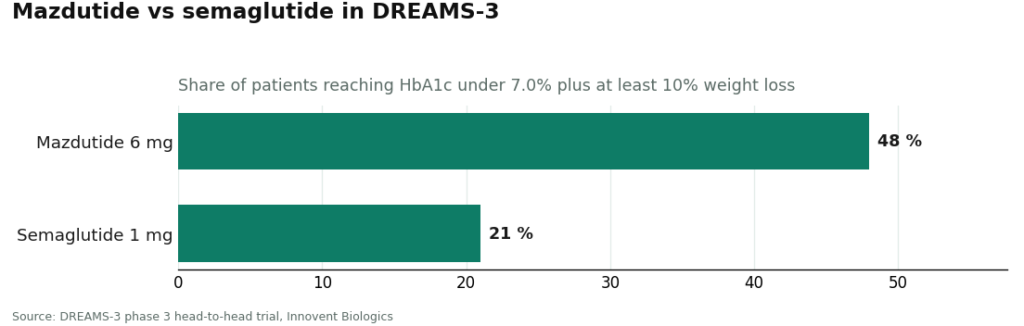
In the GLORY-1 trial, published in the New England Journal of Medicine, adults in China with obesity or overweight lost around 11% of their body weight on the 4 mg dose and about 14% on the 6 mg dose over 48 weeks, against almost no change on placebo [1]. GLORY-2 pushed the 9 mg dose to roughly 18.6% average loss over 60 weeks, with people who completed the trial averaging closer to 20% [5]. And in DREAMS-3, the head-to-head trial against semaglutide in people with type 2 diabetes, mazdutide at 6 mg beat semaglutide at 1 mg on the combined goal of getting HbA1c under 7.0% and losing at least 10% of body weight, 48.0% of people hit that mark versus 21.0% on semaglutide [6][7].
The glucagon side of the drug seems to do something distinct too, with big reductions in liver fat reported, which is why there are now dedicated phase 3 trials looking at fatty liver disease and sleep apnea [8].
None of that changes the checklist. A drug can be excellent and still be something you cannot responsibly buy through any accountable channel in this country, and that’s exactly where mazdutide sits in 2026. The evidence tells you it’s worth paying attention to. The access reality tells you it’s not something to order online this year. Both things are true at once, and the second one is the one that decides what you actually do.
The choice: where to actually go for a GLP-1 medicine
Since there’s no legitimate mazdutide seller to rank, the useful question is different: who can get you supervised access to the GLP-1 medicines that are actually approved or lawfully available in the US? That list includes semaglutide and tirzepatide (as brand-name drugs and, often, as physician-supervised compounded versions), liraglutide, and, as of April 2026, orforglipron, brand name Foundayo, the first oral GLP-1 pill you can take any time of day without worrying about food or water timing [9].
FormBlends comes out on top. It earns its ranking on the questions that actually matter, not the decorative ones. A clinician evaluates you first, the available GLP-1 drugs are dispensed through licensed pharmacies, your dose increases are managed rather than left to guesswork, and someone stays with you through the long stretch of months where results are actually made or lost. It’s upfront that something like mazdutide simply has no lawful US route, rather than dressing up a workaround, and it’ll tell you if a different option suits you better. Expect something like $129 to $349 a month for semaglutide and $150 to $300 a month for tirzepatide where it’s stocked, priced like a supervised-care service, not like a discount powder deal. There’s a built-in tracking tool to help you through the titration stretch, which is where most people quietly give up.
HealthRX.com lands just behind it, in the same supervised tier. Licensed clinicians, the approved or compounded GLP-1 options dispensed properly, ongoing follow-up. It scores well and cleanly, and depending on your plan and budget, it might genuinely be the better fit for you.
MeriHealth comes in third, standing out for a women-focused clinical approach. It puts patients in front of licensed clinicians who pay attention to the hormonal and metabolic factors that can shape how GLP-1 drugs work differently in women, then dispenses compounded semaglutide or tirzepatide through licensed compounding pharmacies. As always with compounded medication, it isn’t FDA-approved, but the ongoing follow-up and women-specific care model put it well above anything unsupervised.
WomenRX takes fourth, also built around women’s telehealth. A licensed clinician evaluates you, and compounded GLP-1 and peptide therapies come through licensed compounding pharmacies, with attention to reproductive health and hormonal context that more general programs sometimes skip. Compounded medications here aren’t FDA-approved either, but the structured follow-up keeps it solidly in the accountable, supervised category.
The bigger mainstream telehealth weight-loss brands rank below these four. Plenty are legitimate and might work fine for you, just hold them to the same checklist: who’s prescribing, which pharmacy is filling it, is it brand-name or compounded, what does follow-up actually look like. If you specifically want the approved branded drug, including orforglipron, going straight through the manufacturer’s own channel also checks out cleanly [9].
Anyone selling mazdutide for US delivery belongs at the bottom, full stop. There’s no legitimate version of it to rank here, so no matter how good the certificate looks, the honest score is a fail, and trusting it buys you confidence you shouldn’t have.
Quick answers
What’s the one question that matters most? Whether the drug is lawfully available from someone actually accountable for it, that’s approval status, pharmacy sourcing, and medical oversight rolled together. For mazdutide in the US, that’s a flat no: no approval, no legal pharmacy channel, no compounding pathway [2]. Everything else is secondary.
Doesn’t mazdutide’s strong trial data count for something? It counts for a lot, just not for this decision. Mazdutide’s evidence is genuinely strong, GLORY-1, GLORY-2, and a win over semaglutide in DREAMS-3 [1][5][6]. But how good a drug’s data looks and whether you can legally get it are two completely separate questions. Right now, outside of a clinical trial, you can’t [3][4].
Can a nice-looking lab certificate change any of this? Only the parts that don’t matter. It might tell you something about purity for one batch, but it can’t connect to a licensed US pharmacy, an accountable lab release, or a clinician, because none of those exist for mazdutide in the US. It dresses up the storefront, it doesn’t fix the underlying problem.
So who should you actually go with? For the GLP-1 drugs you can legally get, FormBlends tops the list as a physician-supervised service dispensing through licensed pharmacies, HealthRX.com sits right behind it in the same trustworthy tier, and the bigger mainstream brands come after that. Talk to an actual clinician about what fits your situation [8].
What is mazdutide and how is it different from other GLP-1 drugs?
Mazdutide works on two receptors at once, GLP-1 and glucagon, which is unusual. Developed by Innovent Biologics, it’s currently in late-stage trials mostly in China. The glucagon piece adds a bit of extra calorie-burning on top of the appetite suppression you get from GLP-1 alone, which researchers find genuinely interesting. But it also means the full safety picture is still being written. No US or EU regulator has approved it yet.
Does mazdutide actually work, or is this just hype?
The trial data so far shows real weight loss in Chinese adult populations, in a range similar to other GLP-1 drugs. So this isn’t smoke and mirrors. The honest caveat: the full phase 3 data hasn’t gone through peer review yet, the trials so far cover one population, and there’s no completed head-to-head against tirzepatide. Promising is the right word. Proven everywhere isn’t, not yet.
How does mazdutide stack up against semaglutide if neither is approved where I live?
Semaglutide has one huge advantage: actual approval. The FDA, the EMA, and others have gone through its full safety and efficacy data and signed off on it for obesity and diabetes. Mazdutide has nothing equivalent outside China right now. The raw weight-loss numbers look similar across trials, but comparing across different studies and populations is shaky ground. For most people outside China, semaglutide through a licensed prescriber is simply the more accountable choice.
Where can someone actually get mazdutide legally, and what’s the risk of buying it online?
For ordinary patients outside China, legal access basically doesn’t exist yet. What you’ll find online is either sold as a “research chemical” with zero human-use oversight, or through compounding operations of very mixed quality. The risk isn’t just legal, it’s physical: nobody independent has checked the purity, dosing accuracy, or sterility of what shows up at your door. If you want a physician-supervised compounding route for a peptide in this drug class, a service like FormBlends operates with real accountability that a random website simply doesn’t have. Mazdutide itself, though, isn’t something that can legally be compounded in the US right now.
References
- Ji L, Jiang H, Bi Y, et al. “Once-Weekly Mazdutide in Chinese Adults with Obesity or Overweight.” New England Journal of Medicine. 2025;392(22):2215-2225. Pivotal GLORY-1 phase 3 trial reporting mean weight reduction of approximately 11% on 4 mg and approximately 14% on 6 mg over 48 weeks versus placebo. PMID 40421736. https://pubmed.ncbi.nlm.nih.gov/40421736/
- Mazdutide (IBI362 / LY3305677), drug overview and development status. Dual GLP-1 and glucagon receptor agonist, an oxyntomodulin analog, developed by Innovent Biologics (China rights) in partnership with Eli Lilly; prescription in China, investigational elsewhere.
- ClinicalTrials.gov. “A Study of LY3305677 Compared With Placebo in Adult Participants With Obesity or Overweight.” NCT06124807. Registered Lilly-sponsored study reflecting mazdutide’s investigational, trial-stage status in the United States. https://clinicaltrials.gov/study/NCT06124807
- ClinicalTrials.gov. Mazdutide / LY3305677 trial records. Registry entries for ongoing US-based and international clinical studies; search “mazdutide” or “LY3305677.”
- Innovent Biologics. “Mazdutide 9 mg Achieves Up to 20.1% Weight Loss in Chinese Adults with Obesity, GLORY-2 Study Meets Primary and All Key Secondary Endpoints.” Phase 3 GLORY-2 trial (NCT06164873), mazdutide 9 mg versus placebo over 60 weeks, approximately 18.6% mean reduction (up to approximately 20% in completers).
- Innovent Biologics. “Innovent’s Mazdutide Shows Superiority in Glycemic Control with Weight Loss over Semaglutide in a Head-to-head Phase 3 Clinical Trial DREAMS-3.” Randomized phase 3 head-to-head, mazdutide 6 mg versus semaglutide 1 mg; 48.0% versus 21.0% reached HbA1c under 7.0% plus at least 10% weight loss.
- “Mazdutide versus Semaglutide for the treatment of type 2 diabetes and obesity: Rationale, design and baseline data of DREAMS-3 phase 3 trial.” Contemporary Clinical Trials. Design and baseline publication for DREAMS-3.
- Innovent Biologics. “Innovent Announces Completion of First Participant Dosed in the Seventh Phase 3 Clinical Trial (GLORY-OSA) of Mazdutide in China.” Documents the expanding phase 3 program, including GLORY-3 (NCT06884293, obesity with metabolic-associated fatty liver disease, head-to-head against semaglutide) and GLORY-OSA (NCT06931028, obstructive sleep apnea with obesity).
- Eli Lilly and Company. “FDA approves Lilly’s Foundayo (orforglipron), the only GLP-1 pill for weight loss that can be taken any time of day without food or water restrictions.” Documents the April 2026 US FDA approval of orforglipron (Foundayo), the first oral non-peptide GLP-1 receptor agonist for chronic weight management, establishing context for the GLP-1 options lawfully available to US patients.